How Ellodoctor’s Digital Records, On-Call Consultations and Coordinated Referral Are Changing School Health
By Dr Bridget Nakakeeto, Telehealth Program Director, Ellodoctor Foundation
When a learner falls seriously ill at school, the outcome rarely turns on a single dramatic decision. It turns on a chain of smaller ones: whether the nurse has the learner’s medical history at hand; whether she can reach a doctor for a second opinion before deciding to refer; whether the receiving hospital knows the learner is coming and why; and whether the parent finds out from the school before they find out from a stranger. Ellodoctor was built around that chain, not around any single link in it.
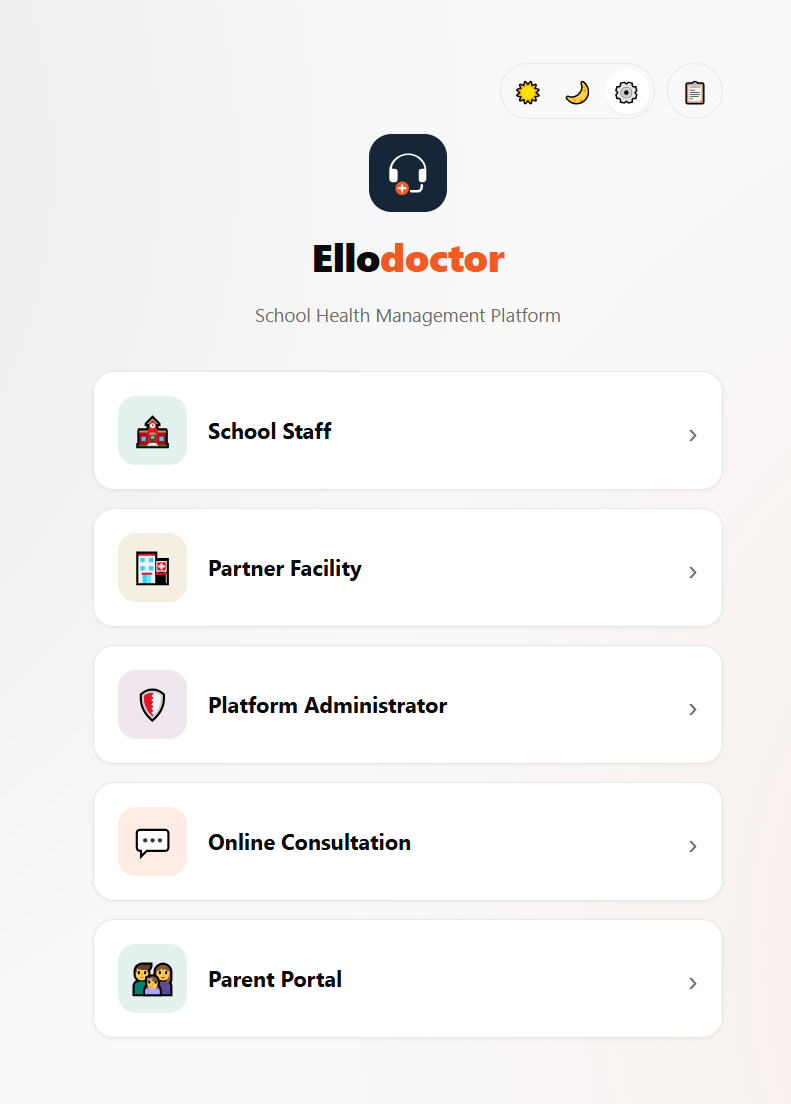
The Ellodoctor School Health, Record and Referral Management Programme brings together three capabilities that are usually found — if at all — in separate systems: a digital health record integrated into the school infirmary or dispensary; on-call teleconsultation with qualified clinicians for learners and the nurses caring for them; and a structured referral pathway to registered hospitals that reports back to both the school and the parent. This article sets out the evidence for why that combination, rather than any one piece alone, is what actually changes outcomes.
Literature Review: What the Evidence Shows
Digital health records. Across sub-Saharan Africa, mHealth, eLearning and telehealth are now the leading categories of digital health solution in active use, with electronic health records increasingly cited as the connective layer that lets other digital tools function (Frontiers in Digital Health, 2026). A 2025 scoping review of digital health interventions used by health professionals across the region found consistent application in medication management and service-delivery coordination, but also flagged persistent gaps in integration, monitoring and sustainability once a pilot moves to scale (Osei et al., 2025) — a caution that shaped how Ellodoctor’s own system was designed, with a localised server for each school rather than dependence on a single central point of failure.
Teleconsultation and referral. Evidence from Kenya on technology-assisted community health referrals found that mobile-technology-supported referral systems measurably improved the speed and completeness of the referral chain at the last mile — precisely the point in the system where a paper-based process is most likely to break down between a community-level worker and a receiving facility (PMC, 2020). Regional evidence on tele-triage in African health systems similarly shows that remote clinical input can shorten the time between a symptom being noticed and a diagnostic pathway being confirmed, particularly where distance or workforce shortages would otherwise delay it (Research Square, 2025).
School-based telehealth specifically. The strongest direct evidence comes from school-based telehealth programmes in the United States, where the model closely mirrors what Ellodoctor is introducing in Uganda: a trained school nurse supported remotely by a clinician, with the school as the point of care. A study by the Medical University of South Carolina, published in JAMA Pediatrics, found that children with access to a school-based telehealth programme were 21% less likely to visit the emergency department for asthma than children without such access, with the programme working specifically by engaging the school nurse to keep learners on their controller medication and to raise day-to-day awareness of asthma management (MUSC, 2019). A separate study of a school-based telemedicine programme across three rural North Carolina counties found a comparable reduction in avoidable emergency care among historically underserved pediatric patients (Mayfield et al., 2023). A broader evidence roundup by the Center for Health Care Strategies and clinical guidance from the American Academy of Pediatrics both conclude that school-based telehealth improves access and continuity of care without increasing avoidable escalation to emergency services (Center for Health Care Strategies, n.d.; American Academy of Pediatrics, 2022).
Case Review: Coordination in Practice
The Children’s Health telemedicine programme in Dallas, Texas, began in 2013 specifically to reach learners where they spend most of their day — in school — after the health system observed rising emergency department use for low-acuity complaints that could safely have been managed at the point of first contact (Children’s Health / American Hospital Association, 2018). The programme’s design principle is the one Ellodoctor has adopted for Uganda’s boarding and high-enrolment schools: put the clinician’s expertise where the learner already is, rather than requiring every uncertain case to travel to where the expertise sits.
In Kenya, the Migori County community health worker programme, run in partnership between the county Ministry of Health and Lwala Community Alliance, professionalised an existing cadre of community health workers by pairing them with structured training, supervision and a defined referral relationship to formal health facilities (Frontiers in Public Health, 2023). The programme’s central finding — that training and structured supervision, not formal education level alone, predicted how well a health worker performed on referral-relevant tasks — is directly relevant to school nurses: it is the combination of training, a clear referral protocol and a responsive receiving system that makes a referral network trustworthy, not any one element in isolation.
How the Ellodoctor Model Works
- Digital health record at the point of care — a dedicated system integrated into the school infirmary or dispensary, giving the nurse instant access to a learner’s history, allergies, medication and prior incidents, with a localised server so the school retains ownership and control of its own data.
- On-call teleconsultation — free online consultations and medical advisory sessions connecting the school nurse (and, where appropriate, the learner and family) directly to a qualified clinician, so a second opinion is available before a referral decision is made, not only after.
- Coordinated referral to registered hospitals — a structured pathway to trusted hospitals, specialists and e-pharmacy services, with the receiving facility briefed in advance and confirmation of arrival and treatment fed back into the same record.
- Two-way feedback to school and parent — every referral generates a coordinated update to both the school (to support continuity of care and return-to-school planning) and the parent or guardian (so that families are informed by the system that is caring for their child, not left to piece events together after the fact).
Why This Coordination Matters
Each capability above has been shown, individually, to improve some part of paediatric care. What the evidence above also shows is that the gains compound when the pieces are connected. A digital record without a referral pathway simply documents an emergency more accurately after it happens. A referral pathway without a shared record forces the receiving hospital to start from zero on arrival. A teleconsultation without feedback to the parent leaves a family finding out about their child’s health event secondhand. Ellodoctor’s design — record, consult, refer, and report back to both school and family as one continuous process — is a direct response to the fragmentation that the literature above identifies as the most common failure point in school and community referral systems.
This is also why Ellodoctor’s approach goes beyond traditional school health services. Preventive elements — pre-school medical check-ups, scheduled mandatory assessments and continuous monitoring — are built into the same platform, aimed at reducing health surprises and limiting avoidable emergencies rather than simply managing them better once they occur.
Why Ellodoctor
Uganda does not lack committed school nurses or willing hospitals. What has been missing is the connective layer between them — the record that travels with the learner, the clinician on call before a crisis, and the referral that reports back. Ellodoctor operates a centralised virtual hospital management platform, understood to be the first of its kind in Uganda, led by a full-time Telehealth Program Director alongside licensed senior consultants and nurses, ensuring that every consultation, medical record, referral and treatment plan is coordinated, updated and visible to every stakeholder who needs it. Schools that adopt this model are not simply buying software; they are closing the coordination gap that the international evidence consistently identifies as the difference between a delayed emergency and a managed one.
References
American Academy of Pediatrics (2022) ‘Telehealth: Opportunities to Improve Access, Quality, and Cost in Pediatric Care’, Pediatrics, 149(3). Available at: https://publications.aap.org/pediatrics/article/149/3/e2021056035/184902 (Accessed: 17 August 2026).
Center for Health Care Strategies (n.d.) School-Based Telehealth Interventions: Evidence Roundup. Available at: https://www.chcs.org/resource/school-based-telehealth-interventions-evidence-roundup/ (Accessed: 17 August 2026).
Children’s Health / American Hospital Association (2018) School-Based Telehealth Program — Case Study. Available at: https://www.aha.org/case-studies/2018-02-14-school-based-telehealth-program-childrens-healthsm (Accessed: 17 August 2026).
Frontiers in Digital Health (2026) ‘Digital health implementation research across selected African countries: a bibliometric analysis of maternal health and infectious diseases with observations on precision medicine representation (2015–2025)’. Available at: https://www.frontiersin.org/journals/digital-health/articles/10.3389/fdgth.2026.1831353/full (Accessed: 17 August 2026).
Frontiers in Public Health (2023) ‘Training and experience outperform literacy and formal education as predictors of community health worker knowledge and performance, results from Rongo sub-county, Kenya’. Available at: https://www.frontiersin.org/journals/public-health/articles/10.3389/fpubh.2023.1120922/full (Accessed: 17 August 2026).
Mayfield, C.A., Priem, J.S., Effinger, T., McGinnis, S. and Grinton, P. (2023) ‘School-Based Telemedicine and Reduced Avoidable Emergency Care Among Rural Pediatric Patients’, Telemedicine and e-Health. Available at: https://journals.sagepub.com/doi/10.1089/tmj.2023.0013 (Accessed: 17 August 2026).
Medical University of South Carolina (MUSC) (2019) ‘School-based telehealth program reduces ED visits by pediatric asthma patients’, MUSC News, 5 November. Available at: https://web.musc.edu/about/news-center/2019/11/05/telehealth-asthma (Accessed: 17 August 2026).
Osei, E., Asante, L.S., Ampon-Wireko, S. and Abdulai, P.M. (2025) ‘Digital health interventions for managing medication and healthcare service delivery by health professionals in Sub-Saharan Africa: A scoping review protocol’, Digital Health. Available at: https://journals.sagepub.com/doi/10.1177/20552076251379770 (Accessed: 17 August 2026).
PMC (2020) ‘Testing mHealth solutions at the last mile: insights from a study of technology-assisted community health referrals in rural Kenya’. Available at: https://pmc.ncbi.nlm.nih.gov/articles/PMC7793019/ (Accessed: 17 August 2026).
Research Square (2025) Digital Health Interventions for Early Cancer Detection and Referral Pathways in Sub-Saharan Africa: A Scoping Review. Preprint. Available at: https://www.researchsquare.com/article/rs-10516743/v1 (Accessed: 17 August 2026).
World Health Organization (2024) Making Every School a Health Promoting School: Implementation Guidance. Geneva: WHO. Available at: https://www.who.int/initiatives/making-every-school-a-health-promoting-school (Accessed: 17 August 2026).